

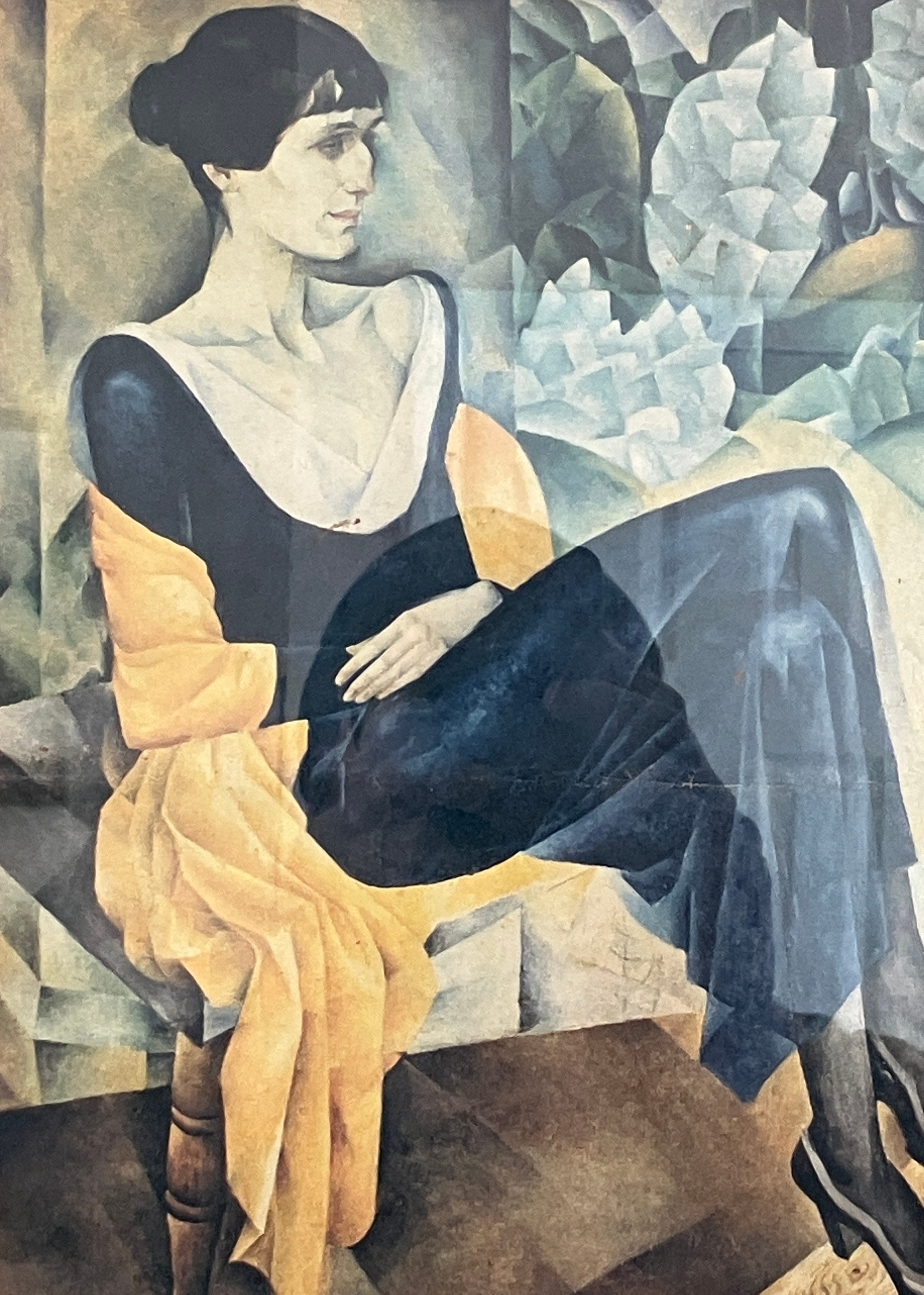
Portrait of Anna Akhmatova by Natan Al’tman. His Cubist Period. Petersburg, 1914
5 March 1966 was the day the world-renowned Russian poet Anna Akhmatova died, the last poet of the Silver Age. Having lived most of her life in the Soviet Union, she was banned, but never became a Soviet poet. This does her great credit. My subscriber, Victoria Stoilova, reminded me of her death 60 years ago, and I dedicate my essay about Anna Akhmatova to Victoria. I am sure she loves her poetry.
Oh, muse of weeping, the most beautiful of all muses!
**************
Anna Akhmatova!— This name—enormous breath,
And it falls to the depth which is nameless.
We are crowned that the same earth
We trample, that the same sky over us—the same!
And one who is wounded by your mortal fate,
Already immortal arises on the mortal bed.
Marina Tsvetaeva
19 June 1916
We, the students of Russian literature of the Leningrad University of the 1960s, were saying over and over again those sacred words; sacred, because both poets— Anna Akhmatova and Marina Tsvetaeva — were banned at that time in our “blessed,” communist country. By the Communists. One, the younger one, Marina, was driven to suicide, and Anna was proclaimed as a half- prostitute and a half-nun in the leading literary journal Zvezda (Star) by A. Zhdanov, the Secretary of the Leningrad Communist Party in 1946. In 1960, we still had to memorize the government’s resolution about Anna Ahmatova. We couldn’t read her poems, but at the exams, we could be asked about that resolution and even be asked to justify it. Soviet education!
We read her banned poems secretly and knew them by heart. It was always possible to find the threadbare lists of paper with her poems and copy them for yourself. They were thrilling versions of our young selves, our own feelings, our love troubles. Nothing political was in those poems.
At 18, she writes Love, which:
Sure and secretly leads
From joy and peace.
Knows how sweetly weep
In the prayer of the longing violin
And so terribly to guess it
In an unknown yet smile.
Любовь
Но верно и тайно ведет
От радости и от покоя.
Умеет так сладко рыдать
В молитве тоскующей скрипки,
И страшно ее угадать
В еще незнакомой улыбке.
And we, girls in our time, looked like her; we smoked, wore the same narrow skirts / to seem more shapely, like Anna in hers: Я одела узкую юбку /Чтоб казаться еще стройней.
Her relations with Nikolai Gumiliov were rather complicated. (I wrote about N. Gumiliov in my essay about him.) He fell in love with her when she was 14, a student at a gymnasium, while he was already finishing school. They both wrote poetry, and Catherine II’s park had been the place of their walks, reading their poems, and remembering Pushkin, all Russians’ favorite poet, who walked the same park paths: Here his cocked hat was laid/ And tattered Parney’s volume, she wrote in her In Tsar Village, where they both lived at the time. Her father, Andrei Gorenko, was a naval engineer, but he didn’t let her use their family name when he heard that she wanted to be a poet. She calmed him down, proclaiming that she had found another name and, laughing, chose the Tatar name of her great-grandmother on her mother's side, and instead of Ukrainian Gorenko, she became famous Akhmatova soon. Gumiliov’s father was a naval doctor. His parents were not afraid that their son would disgrace their name by being a poet, but they worried about his wish to travel to unknown lands at a young age. But he did it under the pretext of studying at the Petersburg University. During his first year as a student, he went on an expedition to Africa, and only Anna and two other friends knew about it.
After several marriage proposals from Gumiliov, she agreed, but their marriage was troubled. Both were too independent; he loved other women (Larisa Reisner, and others); he loved travelling to exotic countries, such as Asia and Africa, to hunt wild animals. At the same time, she went to Paris, where she met Amadeo Modigliani, who drew his famous line of her lying body. In 1914, Gumiliov volunteered for the war and, despite his squint, was accepted. Before that, in 1912, they had a son, but both were preoccupied with their lives, and Lev grew up with Gumiliov’s parents. Their relationship is described in her poem:
Gripped my hands under dark veil…
“ Why are you so pale today?”
— Because I made him dead drunk
With my sharp sorrow.
************
Panicked, I shouted: “Everything was
A joke. If you leave, I die.”
He smiled calmly and formidably
And said: Don’t stand on the wind.”
Сжала руки под темной вуалью…
“Отчего ты сегодня бледна?”
—Оттого что я терпкой печалью
Напоила его допьяна.
Задыхаясь, я крикнула: “Шутка
Все, что было. Уйдешь, я умру.”
Улыбнулся спокойно и жутко
И сказал мне: “Не стой на ветру.”
1911
She excitedly and exactly conveyed the feeling of a deserted woman in her The Song of the Last Meeting:
My breast became helplessly cold,
But my steps were light.
I wore on my right hand
Glove from the left hand.
It seemed like so many steps,
But I knew —they are only three!
Among the maples, the autumn whisper
Asked me: “Die with me…”
It is a song of the last meeting
I looked at the dark house.
Only in the bedroom burned candles
By its indifferently yellow light.
Так беспомощно грудь холодела,
Но шаги мои были легки.
Я на правую руку надела
Перчатку с левой руки.
Показалось, что много ступеней,
А я знала — их только три!
Между кленов шепот оенний
Попросил: “Со мною умри!”
Это песня последней встречи.
Я взглянула на темный дом.
Только в спалне горели свечи
Равнодушно- желтым огнем.
What woman on that earth didn’t feel at least once that edginess and pain of the last meeting!?
Despite all the personal troubles between Gumiliov and Akhmatova, they held each other's literary talents in high esteem. They were ironic toward the older generation of Symbolist poets and, with a group of their friends, S. Gorodetsky, O. Mandelstam, M. Kuz’min, and V. Narbut, they organized a new movement in poetry, which they called —Acmeism (Greek, the highest point), their group —Guild of Poets, and their journal —Apollon (Apolo). Their purpose was to write direct, earthy, strict, clear poetry in direct opposition to the Symbolism of mystic, idealistic, and over-earthly subjects. A. Blok, as an example, with his symbol of a beautiful, unknown woman with her “scents and mists.” Blok answered them with an ironic article, Without Deity, without Inspiration, using the words of everybody’s beloved Pushkin. By the way, they all loved A. Blok’s poetry, despite his symbolism. Blok was unsurpassed. They organized even their literary-artistic cabaret “Stray Dog”, on the corner of the Square of Arts in the second court of building #5. (We, students, run around all literary places, Pushkin, Dostoevsky, Blok, Akhmatova- this is the advantage of studying literature in Leningrad. You forget L-d, you live in Petersburg, with them. You talk about them as alive, you talk sometimes even with them!)
Their cabaret was painted by the well-known theater artist Sergey Sudeikin, and he did an excellent job, painting Flowers of Evil by Bodleier and flying birds on the walls. Cabaret had a stage and a small dance floor. Poets read their work from the stage, as well-known dancers performed, and Akhmatova wrote a poem about that cafe, which is very hard to translate because she used slang and old Russian, not literary language. (If any of my Russian readers wants to help me, please give a better version in the comments):
Все мы бражники здесь, блудницы,
Как невесело вместе нам!
На стенах цветы и птицы
Томятся по облакам.
Ты куришь черную трубку,
Так странен дымок над ней.
Я надела узкую юбку
Чтоб казаться еще стройней.
О, как сердце мое тоскует!
Не смертного ль часа жду?
А та, что сейчас танцует,
Непременно будет в аду.
We are all here, drunkards and harlotts
And how joyless we are together!
On the walls, flowers and birds
Languish about clouds.
You smoke the black pipe,
So strange this smoke over it.
I dressed in a narrow skirt
To look more shapely.
Oh, how my heart is yearning!
Amn’t I waiting for my death hour?
And a woman* who is dancing now
Certainly is going to hell.
19 December 1912
In carriage
(The woman who danced there was a well-known ballerina, Tamara Karsavina. She didn’t go to hell; she made a wonderful career in London ballet, and after she finished dancing, she became one of the leading figures in the English Ballet Administration.)
Cabaret was open from 31 December 1911 to 3 March 1915. Entrance to the cafe was only with an invitation card.
We lived with Akhmatova’s poems because everything that had happened in those poems, happened on our streets, on the same embankments of the Neva river, or, as Marina Tsvetaeva said, we trampled the same earth:
Then, the last time we met
On the embankment, where we always met.
In Neva was a high water,
And all were afraid of the flood.
He talked about summer and about
How to be a poet for a woman is- absurd.
How I remember the tsar's house
And Peter and Paul’s fortress!—
Then, the air was not quite ours,
But like a gift from god— so marvelous.
And in that hour, the last song of
All the mad songs was given to me.
You can trust her poems; she is even totally truthful in her description of herself if you compare her poems and her photos:
On my neck- line of the small rosary,
In the wide muff, I hide my hands,
My eyes look vacant
And never cry again.
And seems my face is paler
From the violet silk,
My uncurled fringe
Almost comes to my eyebrows.
На шее мелких четок ряд
В широкой муфте руки прячу,
Глаза рассеянно глядят
И больше никогда не плачут.
И кажется лицо бледней
От лиловеющего шелка,
Почти доходит до бровей
Моя незавитая челка.
Akmatova wrote about all women’s feelings in such simple, spoken language that her little books, Evening, 1912; Rosary, 1914; White Flock, 1917; Plantain-1921
Well-known and deeply respected theorist of literature, Mikhail Bakhtin, spoke about early Akhmatova in a not very high tone: I knew Anna Akhmatova personally very little. I met her several times. Talked to her only once, and our conversation wasn’t very interesting. Moreover, it seemed to me that she didn’t like to go beyond personal and love topics… It was in the old times, and after that she changed. As you know, early Akhmatova didn’t write philosophical lyrics, not at all. It was clearly an intimate lyric, clearly a woman’s lyric. This didn’t prevent her lyrics from being very highly considered in the art. But her verses didn’t have the depth; she didn’t have depth in her life either. She was interested in people, but somehow, in a feminine way, as a woman senses a man. All the people she divided into the interesting and not, Pure a woman’s logic. That is why I didn’t like her. Besides, she was arrogant. She looked at the ordinary people from top to bottom. This arrogance stayed with her into old age, and even became extreme. . .On the next question, which of the three women poets, Zinaida Guippius, Akhmatova, and Marina Tsvetaeva, Bakhtin accepts as the big poetic personality, Bakhtin answered, Perhaps Marina Tsvetaeva. She has a depth that is absent at the others…
We knew Bakhtin’s name because of his famous book, Problems of Works of Dostoevsky, 1929, about the polyphonic character of Dostoevsky's novels. But only students who chose Dostoevsky as their diploma topic could take the book from the University library with special permission from our dean’s office. Again: Soviet education. I could read everything about Blok, but not Dostoevsky, and vice versa.
We loved both our poets. And they both were prohibited, as was Bakhtin himself, so we knew nothing about his POV on Akhmatova at that time.
What we knew was that the best Petersburg poets, Aleksandr Blok and Anna Akhmatova, accepted the Revolution of 1917, and what followed, I will tell in the next chapter of my narrative.
E
1911
Or, we, girls in our time, wore the same black skirt to seem more shapely:
Я одела черную юбку /Чтоб казаться еще стройней.
Не
19 June 1916
My latest (sorry) thanks to Konstantin Asimonov, Monday to Friday, Jorgan Lowenfeldt, Olena Green, Ann Hendrix, Ken Cambell, Ken Kovak, Mosby Woods, Josef Stitt, Aleksarii, 8th Gen Texan and B.L., Sodac, Samara, Mandy Morris, MetalMoomin, and Alex Rettie for reading and liking my Russian Poets. It is so inspiring to work for you, my readers!
Thank you so much Larisa for this, I found Akhmatova’s poetry during lockdown and was inspired to learn Russian so I could read it in the original ( a work in progress!) . For others like me I highly recommend the bilingual edition The Complete Poems of Anna Akhmatova by Judith Hemschemeyer and Roberta Reeder. Judith Hemschemeyer also learnt Russian specifically in order to read and then translate Akhmatova. See https://worldliteraturetoday.org/blog/literary-tributes/pilgrimage-and-passion-project-remembering-judith-hemschemeyer-renee-h-shea