

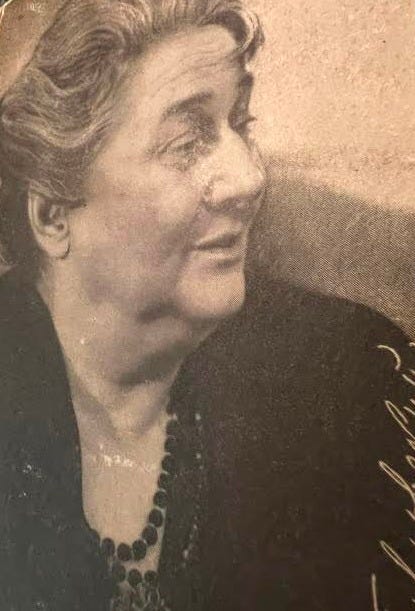
Photo of 1958
Severe epoch turned me
As a river…
Anna Akhmaova
The decision of the Communist Plenum in 1946 to expel Akhmatova and Zoshchenko from the Union of Soviet Writers deprived them of the right to publish, i.e., of making any money to live, to survive. It seems to me, only in the Soviet Union does the government interfere in the artistic decisions of the artists, letting them work on their projects or not, demanding that they follow the party's decisions, sending them to the Gulag camps, even if they don’t suspect that they are under suspicion. By the way, this Plenum decision was revoked only in 1988, 20 years after Akhmatova’s death.
What saved Akhmatova?
Spiritually, she knew, how country loves her poetry. After war, in this short time before that shameful plenum decision, she participated in many public poetic readings with the reading her poetry. After one of that readings with many Soviet poets, she told her friend, Michail Vol’pin: I felt even uncomfortable: when my name was called out, whole hall stood up, like nobody was there, only I was there. Her friend was afraid that such success might bring a lot of troubles for her from the Soviet poets and offered her to stop participating in these poetical evening, but she answered that she needs them. And it is so understandable, but he was right, soon she was stopped.
Then, translations, she translated a lot, and— friends. And her full neglect to the commodities of life; she was a woman of spirit, and she didn’t care about everyday comfort, or a new dress, or new shoes. And her strong character.
The closest of her friends became the Moscow family of Ardovs, whom she met accidentally as the Mandelstams' neighbors in the building. Nina Ol’shevskaya, the young actress and Ardov’s wife, loved Akhmatova's poetry and was happy to befriend her until the end of Akhmatova’s life. Actually, Akhmatova died in her hands. She lived in Moscow, in their apartment very often. First, because she went to Moscow to petition for her son and husband before Stalin, and later, when she became a translator (language didn’t matter, she translated even from Korean), she always stayed in their apartment. The Ol’shevsaya’s older son, our favorite actor, Aleksei Batalov always gave her his tiny room, even when he was married. There, in 1941, she spent a long time in conversation with Marina Tsvetaeva. She never said anything to anybody about that conversation. The second and last their meeting was outside, in some small square, and through another one of her friends, and again nobody heard anything, besides that she “spent seven hours! with Tsvetaeva,” and those “seven hours” didn’t sound very friendly, as her friends remember. We only know that Anna Akhmatova, at that time, was creating The Poem without the Hero about the circle of friends and their lives during the 1920s, and Marina was already “looking for the hook” for suicide, couldn’t care about that time or Akhmatova friends, she actually committed suicide three months later. Marina spoke out, without any admiration, about Akhmatova’s poem about the adventurous and freedom of the 1920s.
The other of her close friends became the daughter of her former civil husband, Nikolai Punin. Irina Punina’s daughter, later considered Akhmatova her very caring adoptive grandmother, as she called her in her book about Anna Akhmatova after Akhmatova’s death.
And which position was left for her son? Very far away from his mother. Anna Akhmatova considered the reason for that to be her son’s very hard character, due to his long time spent in political camps and in a penal battalion. Yes, his character was hard, as his colleagues remember him. He was arrogant, looking down on everybody, as if they had to spend their time in the camps rather than enjoy freedom. He made everybody guilty. Fortunately for him, he was a very purposeful man. Between camps, he graduated from university. In the last settlement after camp, he wrote his dissertation, but he couldn’t finish it without scientific literature. Luckily alive after the penal battalion, he was sent again to the gulag for ten years to Kazakhstan and Siberia, for a settlement. He returned to Leningrad in May of 1956. Worked in the Hermitage. Finished and defended his dissertation on the ethnography topic of the ancient Turkic establishment of the VI-VIII centuries in Asia, at Leningrad University. He became a well-known scientist, believing and propagating the idea that the Russian people are Tatars ( my family name and his, by the way, are Tatar origins), who accepted the religion of Christ. His two books, The Ancient Rus’ (Russia) and the Great Steppe, about that topic, found many followers.
But his relationship with his mother was broken. As Mikhail Vol’pin told about it, Anna Akhmatova wanted very much to introduced her son to Vol’pin and when the time came, she invited him to meet Lev. Having known Akhmatova, her Requiem, all her feeling about her son, he was shocked by the coldness of the meeting between mother and son: Well, I was waiting that this will be some dissolution of all the feelings, something, like, usual humanly tender. I saw two strange human beings. He is absolutely without contact with people, with nobody, and with her, more than with anybody else. And she… I understood that happened the most terrible: so much was given in the separation— and so totally cold, alien meeting, if it’s possible to say about their “strange meeting.”
They didn’t talk to each other for years. Especially, he was offended when she spent her big fee for the book translation on the Moskvich (the smallest Soviet car, named after the Russian capital) as a gift to Aleksei Batalov. Her son didn’t think that his mother had lived in Batalov’s room in Moscow month after month, year after year, and had full care of that family, and wanted to show her gratitude to her close friends. He couldn’t forgive her either for leaving her literary archive, not to him, her heir, but to Irina Punina, who was nobody to her, as he decided. Or maybe he couldn’t forgive her that she couldn’t find him a place to sleep at the Punin’s apartment, besides the corridor, or even earlier, that she left him to spend his childhood far away from her, his mother, with his babushka, his father’s mother, his second wife and their daughter.
As one of her friends, Milena Semiz (daughter of the woman who stood in the line with food for her husband in the prison, and asked Akhmatova to write her future Requiem), and Nadezhda Mandelstam, considered Irina Punina looked not for Akhmatova’s comfort, in life, but for her own advantages as to sell Akhmatova's archive, which she really did after her death. Lev wanted to give his mother's archive to the Central Literature Museum.
The relationship between mother and son was never mended. Akhmatova told Lydia Chukovskaya: Let God be with Liova. He is a sick man. They poisoned his soul there….
In her Notes: Iosif is free… (From camp.) There is no bitterness or arrogance, to fear of which Fyodor Michailovich forbade.(Dostoevsky?) That is why my son was lost. He started to despise and hate people, and he stopped being human himself. God, forgive him. Poor my Liovushka.
Many years after war, Akhmatova was busy with
POEM WITHOUT HERO
Triptych
(1940— 1962)
INSTEAD of PREFACE
Some are not here, others are far away…
Pushkin
First time the poem came to me on 27 December 1940, at night, sending as a messenger one small passage… I didn’t call it. I didn’t even wait for it on that cold and dark day of my last Leningrad winter. That night, I wrote two pieces of the first chapter (1913) and Dedication… I dedicate this poem to the memory of my first listeners— my friends and those who perished in Leningrad during the siege. Their voices I hear when I read a poem aloud, and this secret choir became the justification for me of this work.
8 April 1943, Tashkent
Dedication
… No, it is only a grave of conifer needles,
And, in the boiling of foams
It is closer and closer…
Funeral March
Chopin…
Night
Fontannyi House
INTRODUCTION
FROM THE YEAR of FORTIETH,
AS FROM TOWER, I LOOK ON EVERYTHING.
AS I BID FAREWELL AGAIN,
TO WHAT I ALREADY SAID MY GOOD-BYE,
AS I CROSS MYSELF,
I GO DOWN UNDER DARK VAULTS.
25 August 1941
Besieged Leningrad
Chapter One
NINE HUNDREDTH THIRTEENTH YEAR
PETERSBURG TALE
Evening of the New Year. Fontannyi House. The shadows from 1913, Russia's last peaceful year, come to the poet in December 1940...
I myself as a shadow…
To enjoy — let’s enjoy.
But how could it happen
Only I am alone- alive?
Part II
TAIL
(As in the game, who could guess, heads or tails). Fontannyi House. Beginning of January 1941.
Just now, carried away the infernal harlequinade of 1913, leaving behind the festive or funeral disorder… In a chimney flue, howls the wind.
My editor was displeased,
**********
Who, when, and why was meeting?
Who was killed and who is alive,
Who is the author, and who is the hero,—
And why we need today
These discussions about poet
And some ghosts swarm?
********
And decades are passing,
Wars, deaths, births.
I can’t sing in that horror.
Part III
EPILOGUE
To my city
White night, 24 June 1942. The city is in ruins. Somewhere, the old fires are still burning out. In the garden of Fontannyi* House, lime trees are flowering, the window of the third floor is broken. The author’s voice, seven thousand kilometers far away, pronounces:
Thus, under the roof of Fontannyi House,
Witness to all that happened,
Looks into the room, the old lime tree
And foreseeing our separation,
It expands his dried-out, black hand
To me, as for his help.
(*The building on Fontanka canal, which she called Fontannyi, where she lived many years.)
Endless number of the readers complain about incomprehension of this poem because it is a very personal poem about Petersburg of 1913 and her friends, shadows of which in carnival suits as going to the old balls, visit the poet — the first part; second part— Intermezzo written as a musical entr’acte between shadows of past of her youth and reality of war in the Epilogue. In her first part she told the story of her friend, beautiful and frivolous actress, Ol’ga Glebova- Sudeykinaf for whom one young officer committed suicide when he saw her with her new lover. But the personal passions and cafe Wandering Dog with its concerts of poetry transformed in the last part of poem in the tragic history of the War of 1941-45:
Everything what is said in the first chapter
About love, betrayal and passion,
Reduced to dust.
The central hero of poem became her favorite city— Petersburg, and the feeling of the apocalyptic end and this tragic picture of ruined city and more of million of perished during blockade people makes poem historic epic poem.
And around is old city Piter; city is given in many images - working city- Piter; literary and theatrical- Petersburg. The poet and her friends meet on Isaakiy Square and somehow wander to Dog.
Wind tore away play-bills
And lilac smelled as graveyard,
Dostoevsky and possessed city
Went away into mist.
Akhmatova also put the question of conscience and responsibility:
Who doesn’t cry over the dead,
Who doesn’t know, what the conscience means
And why it exist…
And she asks herself, If am I more guilty than others?
In the sorrowful Epilogue she describes bitterly her parting with her lovely city, her hard route to Ural, and further, to east. She repeats the part of way of the prisoners, the route of people whom she loved, Mandelstam, her son Lev, he husband, Punin. And then, to the South, to Tashkent and return to her Petersburg- Leningrad. She always saw herself inseparable part of the city. Her Epilogue has the dedication:
To my city
You are seditious, disgraced, dear,
Paled, grew numb and quiet.
Our separation is feigned;
You and I are inseparable
My shadow is on your walls,
My reflection is in your canals,
The sound of my steps in the Hermitages‘ rooms,
And in the old Volkovo field,
Where I can sob at large
Over silence of the communal graves…
Poem without Hero wasn’t published at her life time, but she read it once, in 1941, its beginning, at the Leningrad Writers Union, after that, she could read it only to her closed fiends, who knew all the people and events, described in the poem, but the more time was passing, the more explanation needs for the inner content of the poem. Or nothing of it needed, only the admiration of the poetry, especially admiration of her love of Petersburg.
Akhmatova had the hard way in her country and accepted it with the great pride, never complaining; her friends left so many remembrances of her life, like: …she knew tsar’s poverty, almost all her life and carried it utterly marvelously and her poverty, and … her persecution. All that was necessary to survive. … And her female fate is very tragic also. Everything was finishing with a some big tragedy, all her personal relations with the big men, and with her own son… (Galina Kozlovskaya, her Tashkent friend)
Already, in 1940 Akhmatova wrote:
One walks straight line,
The another walks in the circle
* * *
I go —behind me—misfortune,
Not straight, and not slantwise,
But into nowhere and to never
Like derailed trains from the slope.
Anna Akhmatova, of all the Russian poets, deeply loved Aleksandr Pushkin (he was favorite of all Russian writers and poets), she constantly read him, she studied his life and work so seriously that she published several (4) articles about him in the literary journals. Moreover, her love to Pushkin beared some personal character, she hated (not only she) his wife, beautiful Nataly, who lost their child, dancing with Tsar, that Akhmatova friends wrote about her and Pushkin several remembrances. Our famous actress, her close friend, Faina Ranevskaya:
I think that A. A. never loved nobody as she loved Pushkin. I thought about it, when she showed me in some very old magazine Dantes (French man who killed Pushkin on the dual) portrait and said, “ Net, you only look at that!” She held the magazine, pushing it aside, like the stench went from it. Her face was so raged, her eyes were mean... She hated nobody in her life. She hated also Nataly Goncharova (Pushkin’s wife). She talked about it often. And with the intonation that crime was made right now, this minute…
With Stalin death in 1953, slowly her life started to change. All country’s life began to change in the better, lighter, freer atmosphere. (When I write about my native country, I still cannot comprehend, how millions of people subordinated to one, uneducated, non- Russian, cruel usurper, who killed millions of people or get them rot in the Gulag’s camps, including my father.) With Khrushchev started the thaw, so called period of relative respite, after Ilya Erenburg’s novel, The Thaw.
“Enemies of the people” started to return to their homes and being rehabilitated, but some of them didn't survived the Gulag. Akhmatova’s former husband, brilliant Arts’ historian, Nikolai Punin died in the one of camps of North in 1953. She wrote such a sorrowful stanza on his death:
N. P.
And that heart won’t respond me more
To my voice, rejoicing or mourning,
Everything is over… And my song flys
Into empty night, where there are no you.
1953
Punin’s daughter Irina and granddaughter regarded Anna Akhmatova their stepmother and grandmother after her mother and the only Punin’s wife died in the Kazakhstan’s evacuation, despite he left Akhmatova for the other woman. That added fuel to the fire between Akhmatova and her son, Lev Gumiliov, when he returned from his camp in 1956. After Akhmatova left part of her literary archive to them, he never saw his mother again.
But, at last, her life changed unbelievably, to the better. Akhmatova has been reinstated as a member of the Union of Writers, had given even dacha- summer house, actually, a small hut, in 1953, in Komarovo, artistic village, 40 minutes from Leningrad, in the woods, close to the big lake. My friend was working in the 1970s at the Writers House of the Creativity, as a part- time librarian, in Komarovo, and in one of my visits her, we went to see Akhmatova’s dacha. It was a small hut, I am not even sure, it had a sewerage or water system. Maybe it was the reason why Robert Frost, who went to Leningrad to see her, was not allowed it under pretext that she was sick. She even didn’t know about his wish to see her or that she was sick. Anyway, Frost was persistent for Kennedy’s brother was a prominent Slavist and wanted Frost to see “the great poet Anna Akhmatova.” Authority decided to invite Akhmatova and Frost to the more fashionable summer house of some unknown to Akhmatova academic. Akhmatova told about this meeting to her friend, Galina Kozlovskaya:
We are sitting in the wicker armchairs on the terrace and two poets talk. I ask him, —Do you publish Pushkin in your country?
The great American poet made a round eyes and said,
— Who? Never heard.
Then poet asked her,
— Tell me what do you sell?
Anna Andreevna was taken aback,
— Nothing…
—I sell the pine woods, they are good for making the pencils.
And Anna Andreevna tells us,
— Two poets were sitting: one—got all the fame, all the recognition, all the, so called adoration of the country. And I sit next to him, and fate is so different…
Besides dacha, she had a permission to have a personal secretary. She chose one of the group of young poets and translators of her close literary male circle; they called themselves “Akhmatova’s orphans.” One of them was Iosif Brodsky. When he became the prosecuted, she told him, “Now you will be famous, “ and was right. He became famous. (But when he was asked later, living here, in one of many interviews, what poet influenced his poetry, I was surprised, though agreed with him, by his answer: Marina Tsvetaeva, not his friend, Anna Akhmatova.)
Her books started to be published. 1956- her first collection; 1958- second collection, Poems, 1909- 1945, were sold instantaneously. At last, she became famous openly, triumphantly, if before, only in the West, as a band poet, now, in Russia, in her mother country and she looked as a queen, all the people who saw her, wrote about it. But she became old ad ill. Fortunately, she had a time to get her World Prizes in Literature: 1964, December, in Italy, Etna- Taormina, and more prestige one, in 1965, England, Honorary Doctorate at Oxford University.
After her last trip to England, she stated to be seriosely ill, in November 1965, she had third infarct. During that time she was in Moscow, staying with the Ardovs. The end of 1965 and beginning of 1966 hadn’t betoken anything very bad. She continued living at the Ardovs, and to improve her health, Nina Ol’shevskaya 3 march 1966 brought her to Demodedovo (near Moscow), Cardio sanatorium, which Akhmatova loved: here is good and magically quiet— Anna Akhmatova’s last words about her last place on that earth.
5 March, morning, Anna Andreevna felt poorly,’ Nina Antonovna called the doctors immediately. At 11 am, coming out fro her room, doctors told N.A. that Akhmatova died. (L.V. Gornung, Remembering Anna Akhmatova)
From Moscow, the Ardovs and friends transported Akhmatova’s body to Leningrad, where, in the Cathedral of St. Nikolay was read burial service for her. Her son, who didn’t see his mothers for years, cried that it would be better, if died he, not her, his mother. The crowds of people, including my friends, surrounded the church in that cold March day. They came to say their last farewell to poet, whom they loved so much. Then her body was transported to the House of Writers for the last farewell, and then to her favorite Komarovo and buried on the local cemetery.
This is tragedy and triumph of human life of the poet of genius, fully dependent on the political decisions of one crazy man and his system.
Bibliography:
Анна Ахматова Стихи и Проза, Лениздат, 1977
Лидия Чуковская Записки об Анне Ахматовой М., т.т. 1-3 1997
Анна Ахматова в записях Дувакина, М., 1999
Анна Ахматова. А. И. Павловский Лениздат, 1966
PS. To my readers: If you love some poems of Anna Akhmatova, send them to my post Russian Arts and Beyond, and I post them to share her poetry.
Thank you for reading,
Larisa Rimerman
When I went up to Oxford ten years after her honorary doctorate, she was still in the air. People I knew (!) continued to quote her extemporaneous musings. Among 700 years’ worth of ghosts wafting about that place, hers was by far the prevailing one, at least then.
Thank you, Larisa. When I studied Russian and Soviet literature in the late 1960's (with emigré professors), the material about every author and every poet was given in a format like a menu that we had to memorize. Fortunately we got to read the literature in Russian — all except for Pasternak.