
Ivan Bunin
SUNSTROKE

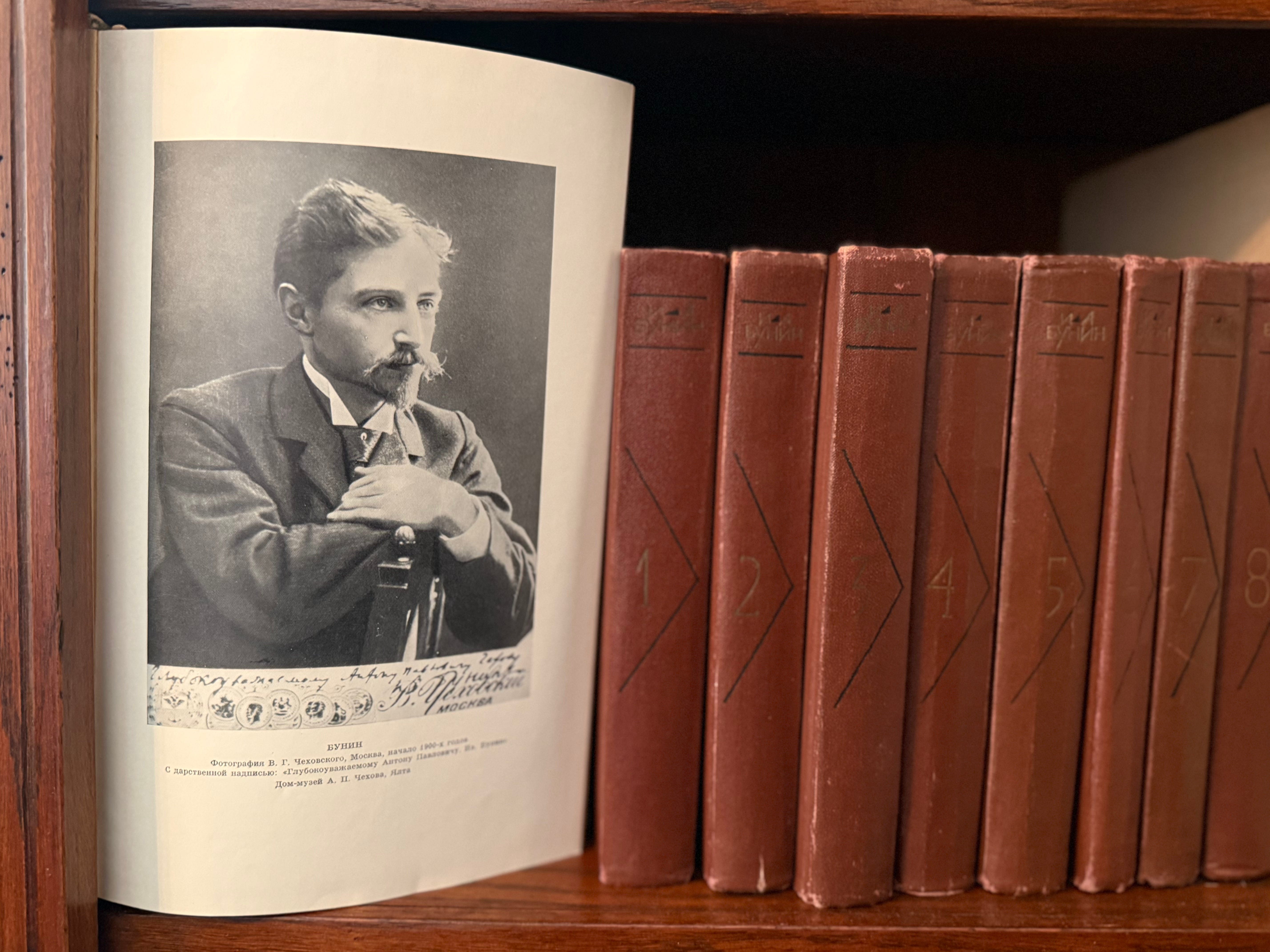
Photo of Ivan Bunin from the beginning of the 1900s, presented to Anton Chekhov with the dedicatory inscription: "Deeply respected, to Anton Pavlovich Chekhov." Iv. Bunin
Not accepting the Revolution, Bunin, with his wife, settled in Paris, continuing to write his amazing stories about Russia of the past times, publishing them in Russian journals and Russian Publishing Houses abroad. In December of 1933, he received the Nobel Prize in Literature for his artistry and his fidelity to the traditions of Russian literature. He was the first Russian writer to receive the Nobel Prize.
I am offering my translation of his story, Sunstroke about failed love. I made this translation for my Substack friend Portia, who knows Russian literature very well, having studied it at a Soviet Russian university as a foreign student at the time when Bunin was banned in the Soviet Union. And for all of you who will read Bunin for the first time. Enjoy!
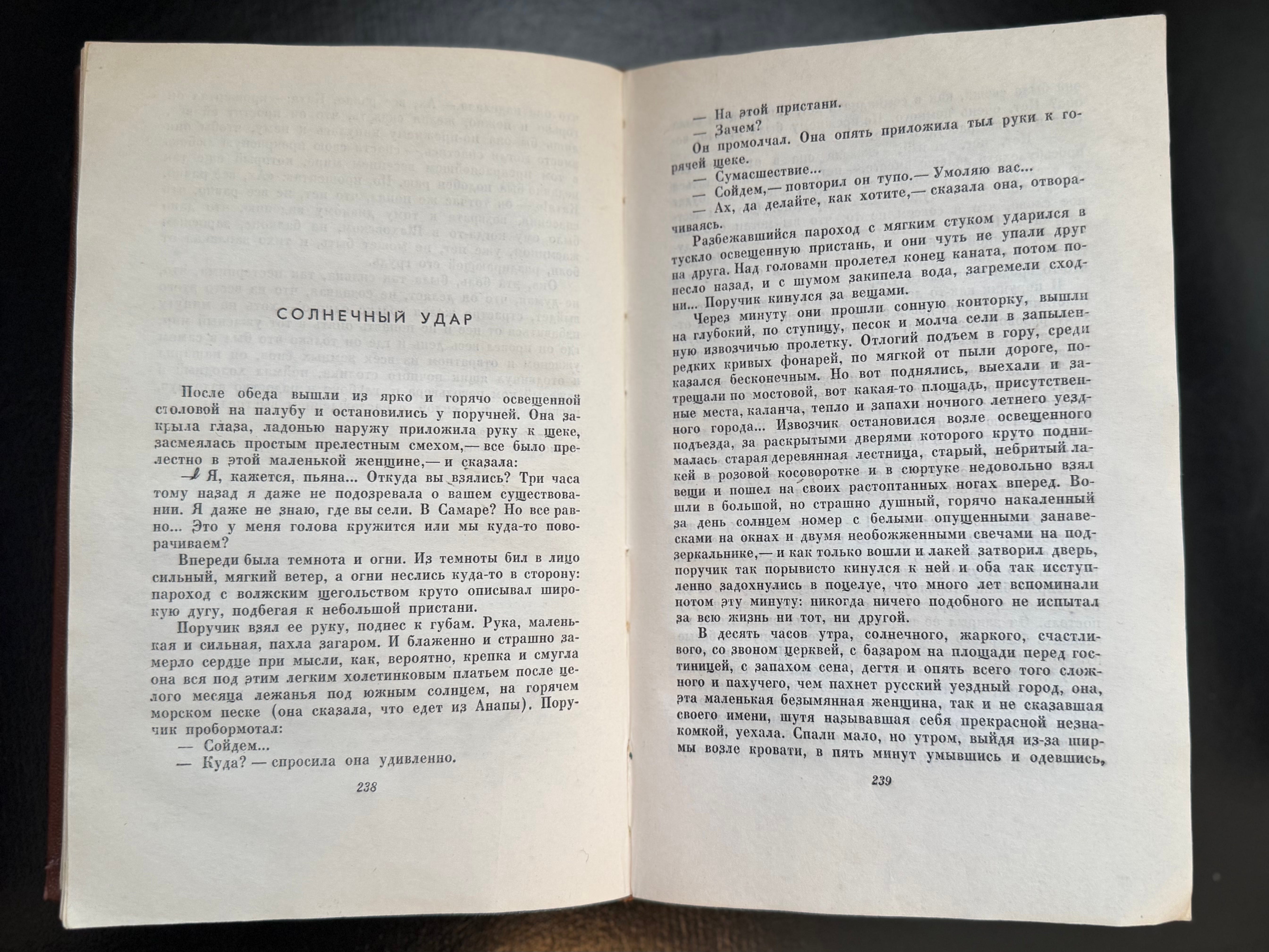
SUNSTROKE
After dinner, they left the brightly lit dining room for the deck and stopped by the handrails. She closed her eyes, put the outside palm of her hand to her cheek, laughed with her simple, charming laugh, —everything was lovely in that small woman, and said:
— I am drunk, it seems… Where are you from? Three hours ago, I didn’t even suspect your existence. I don’t even know where you boarded the ship. At Samara? But it doesn’t matter… Oh, my head… Is it going round, or are we turning somewhere?
Ahead were darkness and lights. From the darkness, the strong, soft wind beat the face, and the lights drifted somewhere aside: a steamship, with Volga’s foppishness, sharply circled a wide arc, sailing up to the small pier.
The lieutenant took her hand and brought it to his lips. Her hand, small and strong, had a suntan smell. And blissfully and terribly, his heart stopped beating at the thought of how, probably, strong and dark she all was under this light, gingham dress after a whole month of lying down under the south sun on the hot sand (she told that she was going from Anapa). Lieutenant muttered:
— Get off…
— Where? she asked, surprised.
—On this landing pier.
—Why?
He said nothing. She again put the back of her hand to her cheek.
— Madness…
— Come off, he repeated dully. — I implore you…
Ah, do as you wish,— she said, looking away from him.
Running up, a steamship, with a soft thump, struck into the dimly lit pier, and they almost fell into each other. Over their heads flew the end of the rope, then floated back, and with the noise, the water boiled, roared the gangway… Lieutenant rushed for their baggage.
In one minute, they passed the sleepy bureau, came out into the deep, to the foot of sand, and mounted the dusty droshky. Sloping rise into the hill, among the rare, crooked lampposts seemed endless. But at last climbed up, rode out, and cracked the road; here is some square, some official buildings, a watchtower, warm and smelling of the night, summer uyezd* town… Cabby stopped in front of the lit entrance, behind the open doors. The old wooden staircase went steeply up. An old, unshaven lackey in a rose blouse with the fastening at the side collar and a frock coat took their belongings and went forward on his trampled legs. They entered a big, but terribly stuffy, white-hot by the sun for the whole day, room, with white drawn blinds on the windows and two unburned candles on the pier-glass table,—and as they stepped in, and the lackey closed the door, the lieutenant so gustily rushed to her, and both so frenzily suffocated in the kiss that many years later remembered that minute: never nothing like that nither he, hor she experienced for a whole life.
At ten o’clock of the sunny, hot, happy morning, with the bell peal, the bazaar in the town square, in front of the hotel, with the smell of hay, tar, and again, all of what is complicated and strong-smelling of the Russian uyezd town, she, this small, nameless woman, just like that, jokingly named herself as a beautiful stranger, had left. They slept a little, but in the morning, coming out from behind a screen by the bed, in five minutes of washing and dressing, she was fresh as in seventeen. Has she been embarrassed? No, very little. As before, she was simple, gay, and already sober-minded.
— No, no, dear, — she answered to his request to go together,— no, you have to wait for the next steamship. If we go together, everything will be spoiled. This will be very unpleasant to me. I give you my honest word that I am not at all what you could think of me. Never, not even anything like what happened with me here, had been or will be. It was like an eclipse… Or, rather, we both got something, like the sunstroke…
And the lieutenant somehow lightly agreed with her. In a light and happy spirit, he took her to the pier, exactly to the departure of the rose Samolet; he kissed her on the deck in the presence of all, and could hardly reach the gangplank, which was already moved behind.
In the same way, lighthearted and carefree, he returned to the hotel. However, something has already changed. The room without her seemed like something different than with her. It still had been full with her, — and empty. It was strange! Her good English cologne was still in the air, and her half-drank cup was still on the tray, but she wasn’t here… And suddenly, the lieutenant’s heart was clenched with such tenderness that the lieutenant hurried to smoke and several times walked through the room.
—Strange adventure! — he said loudly, laughing and feeling that the tears were piling up in his eyes. — “I give my honest word that I am not what you could think…” And she left already…
The screen was moved, but the bed was not yet made. And he felt that now he simply had no strength to look at that bed. He closed the screen, closed the windows not to hear the bazaar noise and the squeak of wheels, drew the blinds, and sat on the divan… Yes, that is the end of that “road adventure!” She left—and now already far away, sits, probably, in the glass white salon or on the deck and looks on the huge, brilliant under the sun river, on the oncoming rafts, on the yellow sand-banks, on the shining distance of water and sky, on all that immense Volga expanse… And forgive me, it is already forever, for life… Because where can they now meet? —Can I, he thought, can I, all of a sudden, come to that town, where her husband, her three-year-old girl, all her family, and all her regular life!— And this town seemed to him somehow special, a sanctuary, and the thought that she would continue to live in this town by her lonely life, maybe often remembering their chance meeting, so fleeting, and he would never see her, this thought astounded and shocked him. No, it is impossible! It would be too savage, unnatural, unthethful!—And he felt such a pain and such the needlesness of his future life without her, that he was seized with panic, with despair.
Damn it! —he thought, getting up, and again, starting his walk around the room and trying not to look at the bed behind the screen. What is it with me? And what is so special about her, and what, strictly, happened? Exactly, as a kind of sunstroke. And, the main thing, how will I spend the whole day in this nowhere without her?
He still remembered her whole, with all her smallest details, remembered the smell of her sunburn and her dress, her strong body, alive, simple, and merry sound of her voice… The feeling of the only just happened delight of her feminine loveliness was so unusually alive in him, but now the main thing was the second, absolutely new feeling—this strange, inconprehencible feeling, which was absent when they were together, which he couldn’t even presuppose in himself, venturing yesterday this, as he thought, only amusing acquaintance, and about which he can’t tell her now! — And, the main thing — you never will tell her! And what to do, how to live this endless day, with these rememberings, with this unsoled torment in this god-forgotten town, over that radiant Volga, by which she was carried by that rose steamship.
It was necessary to be saved, to do something, to divert himself to go somewhere. Decidedly, he put on his cap, took his stick, and went, following the sound of his spurs by the empty corridor, ran down the staircase… Yes, but where to go? By the entrance, the driver, young and in a smart undershirt, calmly smoked a hand-rolled cigarette.
Lieutenant looked at him, confused and surprised: how is it possible to sit on the coach-box so calmly, smoke, and be so simple, careless, and indifferent?— “Possibly, only I alone so terribly unhappy in this whole town,” thought he, going in the direction of the bazaar.
Bazaar was already over. He, for some reason, walked in the fresh manure among the carts, the cartloads with cucumbers, among new pots and bowls, and the peasant women, sitting on the ground, outdid others calling him, taking their pots in their hands, and knocking them, showed their durability, muzhiks deafened him by their cries, ”here, the first sort, cucambers, Your Honor! Everything was so silly, so odd, he ran away from the bazaar. He went to the cathedral, where a choir sang loudly, merrily, and decisively, with the sense of deliberate duty, then walked, circled long around a small, hot, and neglected garden, over a precipice of mountain above the huge, clear-steel width of the river… His uniform jacket’s shoulder straps and buttons were so hot that it was impossible to touch them. The band of his peaked cap was wet inside from perspiration, and his face was flushed… Returning to the hotel, he went with pleasure to the big, empty, cool restaurant on the first floor, and with pleasure took off his cap and sat down by the open window, into which drifted heat, but nevertheless, there was some air blowing, and ordered botvinia with ice. Everything was good, in everything was a boundless happiness, great joy, even in this intense heat, and in all the bazaar smells, and in that all unknown town, and in that old uyezd hotel, everywhere was joy, but all together his heart was broken to pieces. He drank several glasses of vodka, eating the fresh-salted cucumbers with dill, and feeling that he was ready to die tomorrow, not even a minute hesitating, if it was possible by some miracle, to return her, to spend together one more day, today,—to spend only to say out and to prove, to convince her, how tormentingly and ecstaticly he loves her… Why prove? Why convince? He didn’t know why, but it was more than life.
—My nerves are completely shot! —he said, filling up the fifth glass of vodka.
He moved aside his cold borsch, asked for the black coffee, and started to smoke and think with strained attention: what to do now, how to get rid of that sudden, unexpected love? But to get rid of— he felt it too vividly— was impossible. And suddenly, he stood up quickly, took his cap and stick, and, asking where the post office was, hurried there, with a fixed phrase for a telegram, already written: “From now, all my life, forever, until the end is yours, in your power.” But reaching the old, thick-walled building, where the post-office and the telegraph, he stopped in horror: he knew the name of the city where she lives, knew that she has a husband and a three-year-old daughter, but he didn’t know either her last or first name! he asked her several times during their dinner and in the hotel, and every time she laghed and said:
—Why do you need to know who I am and what my name is?
On the corner, by the post office, was a photo in a Photoshop window. He looked at the big portrait of a military man with epaulets, bulging eyes, a low forehead, strikingly splendid side whiskers, with the widest breast, fully decorated with orders… How it is wild, terrible, all the dull, and ordinary, when the heart is struck by, yes, struck, he now understood,—by this terrible “sunstroke”, by this too big love, by this too big happiness! He looked at the newlywed couple - a young man, in a long frock coat and in a white necktie, cut in the hedgehog style, standing erect, arm in arm with a girl in a wedding gauze… Then, oppressed by the agonizing envy of all these unknown to him, not suffering people, began to look along the street with tension.
— Where to go? What to do?
The street was totally empty. Houses were all the same, white, two stories, the merchant class, with big gardens, and it seemed that not one soul was there; white, thick dust lay on the paved roadway, and all that was blinded, everything was flooded by hot, ardent, and joyous, but here, useless sun. In the distance, the street went up, stooped, and stretched into the cloudless, greyish sky. In all, there was something southern, like Sevastopol, Kerch, and Anapa. That was especially unbearable. And lieutenant, with his hanging-down head, screwing up eyes, looking with concentration under his legs, swaying, stumbling over, clinging one spur to the other, walked back.
He returned to the hotel, so beaten by tiredness, as if he had made a tremendous passage somewhere in Turkestan or the Sahara. Collecting his last strength, he entered his big and empty room. The room was already cleaned and lacked her last traces —only one hairpin, forgotten by her, lay on the night table! He took off his jacket and looked at the mirror: his face,— a regular lieutenant face, gray of the sunburn, with his whitish, faded from the sun mustaches, and bluish whiteness of eyes, from sunburn seemed even more white,—had now an excitable, mad expression, and in his white, thin shirt with the starched upright collar was something young and deeply unhappy. He lay on the bed, on his back, putting down his dusty boots on the bed’s casting off. Windows were open, curtains were down, and light wind from time to time inflated them, blew in the room the heat of the hot iron roofs, and all of this luminous and totally now desolated, silent of Volga’s world. He lay, putting his hands under the back of his head and staring fixedly in front of himself. Then he clenched his teeth, closed his eyelids, feeling that along his cheeks rolled the tears -and, at last, fell asleep, and when he opened his eyes again, behind the curtains there was already red from the evening sun. Wind calmed down; the room was stuffy and dry, like an oven… And yesterday and today’s morning were remembered in the way they were like ten years ago.
Not hurrying, he got up, not hurrying, he washed himsef, lifted the curtains, called and asked for the tea and bill, and very long drank tea with lemon. Then ordered a cabman to carry his baggage, and, taking the red, faded seat in the horse-cab, gave the whole five rubles to a footman.
— It’s like, your honor, I brought you here yesterday, driver said gayly, taking reins in his hands.
When they came down to the pier, over the Volga already descended the blue summer night, and the river was strewn with many - colored little lights, and lights were hanging on the masts of the approaching steamer.
— Accurately delivered! — said the driver, ingratiating himself.
The lieutenant also gave him five rubles, took the ticket, and went to the pier…
The same as yesterday: a soft tap against its mooring, and light dizziness from the unsteadiness underfoot; the noise of the boiling, running water ahead of the steamer, which drew back a bit. And everything seemed unusually welcoming, good from the crowds of the steamer, already lighted everywhere and smelling of the kitchen.
In a minute, they went farther, up there, where she flew away, not long ago, in the morning.
Dark summer dawn went out far away, gloomy, sleepy, and reflecting in the water in different colors, yet, here and there, lighted, trembling ripples far away, under it, that dawn swam and swam those lights back, dispersed in the darkness around.
The lieutenant sat under the awning on the deck, feeling himself ten years older.
Маritime Alps. 1925
TRANSLATION of DOSTOEVSKY’S TITLE of NOVEL, BESY -- Demons or Devils? -into ENGLISH
Larisa Rimerman
Aug 11, 2025
Larisa’s Substack is a reader-supported publication. To receive new posts and support my work, consider becoming a free or paid subscriber.
I want to talk about the translation of the title of Dostoevsky’s novel Бесы (Besy) into English. Novel has been translated many times and always in two variants: Some of the translators used the title “Demons,” and others used the title “Devils.”
Understanding that the title of the novel must correspond to the central theme of the book, as reflected already in the title of the author, is an indubitable requirement of the translators. So, what is the reason for such a different approach to the title of the novel Besy by the last two translations of the novel?
The award-winning translators Richard Pevear and Larissa Volokhonsky chose the title “Demons” for the novel. Professor Michel R. Katz preferred “Devils.”
Dostoevsky wrote a satirical political novel about the young, new layer of the Russian intelligentsia of the 1860s—socialists and nihilists, whom he called “Besy.” They are the revolutionaries, petty, hostile, cruel, and ready for any crime, and they committed a crime, killing their comrade, only because he left their group. Dostoevsky called his novel a pamphlet-lampoon, so much he hated this crowd of nihilists and their leader, Nechaev, and creator in literature, Ivan Turgenev, whose caricatures he wrote under the names of Verhovensky and of a writer, Karmazinov, Semion Egorovich.
As in his previous novels, Dostoevsky also presents the philosophical and religious theme of God. These revolutionaries don’t believe in God and are sure that everything is permitted to them, even murder.
Dostoevsky prefaces his novel with two epigraphs about besy: first, from A. Pushkin, and second, from a passage in the Gospel of Luke.
A. Pushkin:
Хоть убей, следа не видно
Сбились мы. Что делать нам!
В поле бес нас водит, видно,
Да кружит по сторонам.
Сколько их! куда их гонят?
Что так жалобно поют?
Домового ли хоронят,
Ведьму ль замуж выдают?
Richard Pevear and Larissa Volokhonsky’s translation:
Upon my life, the tracks have vanished,
We’ve lost our way, what shall we do?
It must be a demon’s leading us
This way and around the fields.
How many are there? Where have they flown to?
Why do they sing so plaintively?
Are they burying some household goblin?
Is it some witch’s wedding day?
Translation by Michael R. Katz:
Strike me dead, but I can’t see the track,
We’ve lost our way, what are we to do?
A devil seems to be leading us unto the field.
I have to ask my subscribers and readers for their forgiveness that my Bunin somehow, and I still don't understand, -how it happened, was followed by my old essay about the translation of Dostoevsky's Devils. I am very sorry for the inconvenience.
My thanks to Ichristopher, Emica Oko, Patric Kinville, Bret Hetherington, Jorgen Lownfeldt, and 20 others for liking my translation of Ivan Bunin.